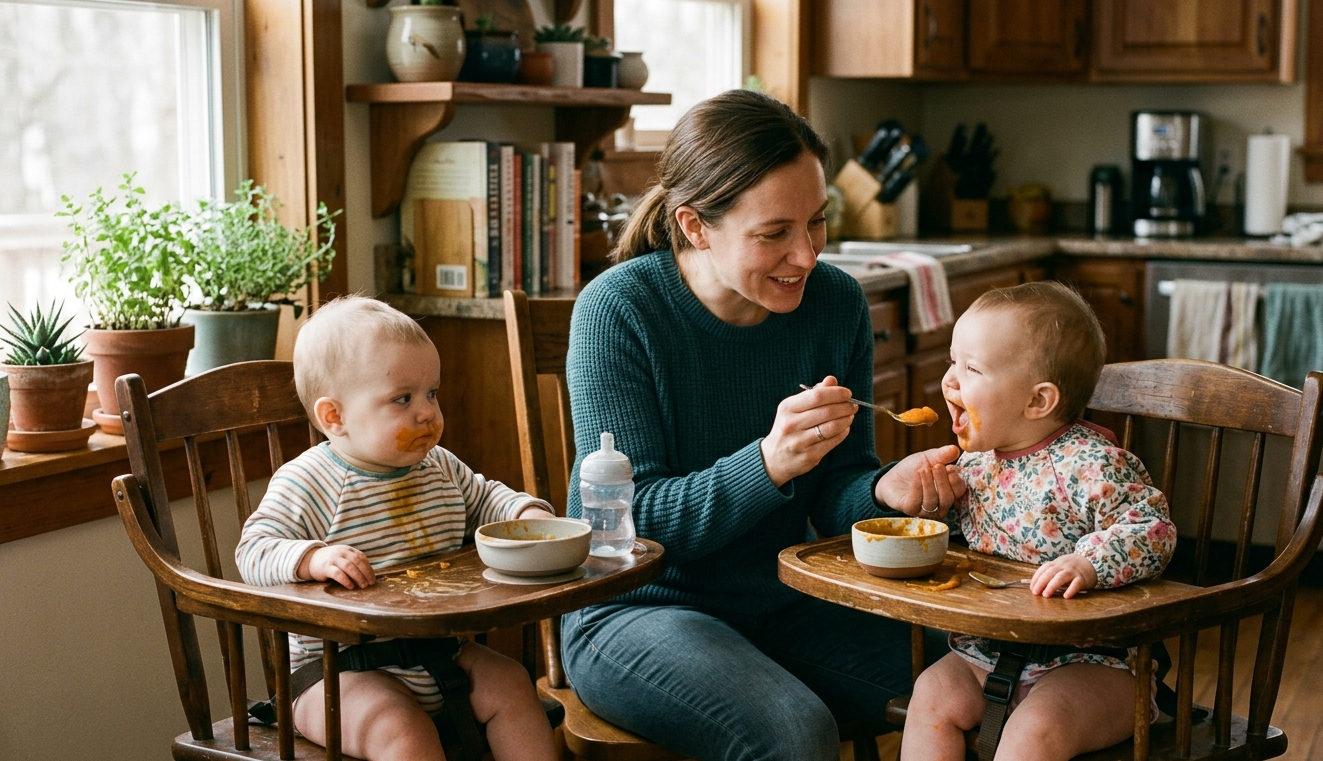
I still think about the first time I tried to give my girls solid food. I had pureed a small amount of sweet potato, warmed it up, wiped down two high chair trays, and sat down between them feeling very prepared. One of my daughters opened her mouth like a little bird. The other stared at the spoon like I was pointing something dangerous at her face and then slowly pushed her lips together into a hard no.
That’s pretty much how starting solids goes with twins. One thing at a time rarely applies. Two babies, two opinions, one parent covered in orange mush.
The short version: most twins are ready for solids around 6 months (adjusted age if they were premature), based on developmental signs, not the calendar. Start with iron-rich foods, introduce allergens early, and lean on purees at the beginning for your own sanity. Everything below is the longer version, with the research behind it and the twin-specific logistics that general parenting sites leave out.
When Are Twins Actually Ready?
The general recommendation from the American Academy of Pediatrics is to start solid foods around 6 months. But “around 6 months” is doing a lot of work in that sentence. What it really means is: when your babies show signs of developmental readiness, which often happens near the 6-month mark.
The signs to look for in each baby:
- She can sit upright with minimal support and hold her head steady
- She shows clear interest in what you’re eating, tracking food with her eyes or reaching for it
- The tongue-thrust reflex has faded. This is the automatic response that makes babies push things out of their mouths with their tongue. When it’s still strong, they’ll push the spoon right back out every time. That’s not picky eating; that’s just their nervous system not being ready yet.
- She opens her mouth when food comes toward her
No single sign is enough on its own. All of them together tell you a baby is genuinely ready to start learning how to eat.
One thing to be aware of: those signs matter more than the date on the calendar. Don’t rush into solids because someone’s twins started at 5.5 months and it went great. And don’t hold off if your babies are showing every sign of readiness at 6 months.
The Adjusted Age Question
If your twins were born early, and statistically there’s a good chance they were since about 60% of twin pregnancies deliver before 37 weeks, you need to use their adjusted age when thinking about solids, not their actual age.
Adjusted age is simply how old your babies would be if they had been born on their due date. If they were born 6 weeks early and are now 7 months old by the calendar, their adjusted age is closer to 5.5 months. That matters a lot for readiness. Introducing solids before a baby’s gut and motor system are developmentally prepared can create real problems, including feeding difficulties that stick around long past infancy.
Your pediatrician should be guiding you on this. If they haven’t brought it up, ask directly: “Should we be thinking about solids in terms of adjusted age?” The answer will almost always be yes for premature twins.
The good news is that the developmental readiness signs above are the same regardless of what caused the delay. When your babies are sitting with support, showing interest, and the tongue thrust is gone, they’re ready. Whether that happens at 6 months actual or 7 months adjusted doesn’t really matter.
Start with Iron
The main nutritional reason to start solids around 6 months is iron.
Babies are born with iron stores from pregnancy, but those stores run out around 6 months. Up until that point, breast milk or formula covers their needs. After that, breast milk alone doesn’t contain enough iron to keep up with what a growing baby needs. Formula has it added, but if you’re breastfeeding your girls even partially, iron-rich first foods are important.
Iron supports brain development, oxygen transport, and energy. A 2021 review in Current Developments in Nutrition found that iron deficiency in infancy is linked to impacts on cognitive development, language acquisition, and motor skills, and that those effects can persist even after iron levels are corrected. Not something to be casual about.
The best first foods are iron-rich ones:
- Pureed or mashed meat (chicken, beef, lamb) is one of the best sources of heme iron, which the body absorbs more easily than plant-based iron
- Iron-fortified infant cereal works too, though it has fallen out of favor a bit as a first food
- Beans and lentils are solid non-heme iron sources; pair them with something vitamin-C-rich like mashed sweet potato or pureed mango to help absorption
- Dark leafy greens like pureed spinach contain iron but should be paired with a vitamin C food for the same reason
You don’t have to start with a single-grain cereal if you don’t want to. Pureed meat, mashed avocado mixed with pureed chicken, or a simple bean puree are all perfectly good first foods. The old “start with cereal, then vegetables, then fruit” rule isn’t required. What matters is that iron-rich foods are in the rotation early.
Introduce Allergens Early
The allergen guidance used to be the opposite, so it confuses a lot of parents. For years, the recommendation was to delay common allergens. Now the research says the opposite: introducing them early actually reduces your babies’ risk of developing allergies.
The LEAP trial, a landmark clinical study, found that babies who were regularly exposed to peanut protein between 4 and 11 months had an 81% lower rate of peanut allergy by age 5 compared to babies who avoided it. The AAP has since updated its guidance to encourage early introduction of all major allergens for most infants.
The top 9 allergens are peanuts, tree nuts, eggs, dairy, wheat, soy, fish, shellfish, and sesame.
A few practical points for twins:
- Introduce one new allergen at a time and wait 3 to 5 days before adding another. This gives you time to watch for a reaction and know which food caused it.
- For each twin, the introduction window is the same. You can do them at the same time; there’s no reason to stagger by twin.
- Reactions to watch for include hives, swelling around the face, vomiting, or breathing difficulty. Mild reactions (a little redness) aren’t the same as anaphylaxis. If you’re ever in doubt, call your pediatrician or go to urgent care.
- If your babies have severe eczema or an existing egg allergy, talk to your pediatrician before introducing peanut specifically. High-risk babies may need allergy testing first.
For more on how food allergies can affect twins and what to watch for as they get older, our article on food allergies in twins covers it in more detail.
Purees, Baby-Led Weaning, or Both?
Baby-led weaning (BLW) means skipping spoon-fed purees and offering soft finger foods right from the start. Instead of you scooping food into their mouths, the babies pick up pieces and feed themselves. The case for BLW is that it lets babies explore food at their own pace and practice self-feeding early, though research hasn’t yet shown clear advantages over spoon-feeding for long-term eating habits.
Purees mean traditional spoon-feeding. You make or buy smooth food, load a spoon, and babies open up. The case for purees is that you know roughly how much they’ve eaten, and the mess is at least somewhat contained.
With twins, purees are easier at the start. When you’re managing two babies at the same time and still trying to keep some version of a schedule together, BLW in the early weeks adds a layer of chaos that doesn’t always serve you well. Finger foods require constant supervision, a lot of patience, and the ability to sit there while a baby gums a piece of soft cooked carrot for four minutes without swallowing it. Multiply that by two.
Many twin families start with purees and introduce soft finger foods around 7 to 8 months once the babies have better hand-to-mouth coordination. Others do a mix from the beginning. Neither is wrong. The goal is that your babies are eating a variety of foods and learning that eating is a good thing. Pick the approach that keeps you sane, and adjust as they get older.
The Reality of Feeding Two at the Same Time
Sit the high chairs next to each other so you can reach both without relocating. Get long-sleeved bibs for each of them. Get more than you think you need. You’ll rinse them out at the sink and go through two or three per meal for a while.
Use one bowl and alternate spoons between babies if you’re doing purees. They’re already sharing a household full of germs; the same spoon isn’t your problem. One bowl also means you’re not doing the math on two portions when you’re already managing two babies.
Start with one solid feeding a day, in the morning or at lunchtime, not before bed. You want to be able to watch for any reactions and you want the babies rested enough to actually try something new. Evening introductions of new foods can make for a long night if one of them doesn’t tolerate something well. If you’re still working on getting your twins on a predictable schedule, our article on twin infant sleep covers that side of the equation.
When one baby refuses a food, offer it to the other. With twins you almost never waste food the way a singleton parent does. The chances that both of them hate the same thing at the same time are lower than you’d think.
Don’t expect full participation from either of them for a while. The first few weeks of solids are practice, not nutrition. Breast milk or formula is still the primary source of calories for the entire first year. If a session results in three licks of butternut squash puree and two protests, that counts as a success.
When One is Ready and the Other is Not
This is common and worth preparing for. One twin may hit all the readiness signs a few weeks before the other. She’s sitting up, grabbing everything, and lunging for your fork. Her sister is still a little wobbly in the high chair and seems completely indifferent to food.
Start the ready one. But try not to let the gap stretch more than a few weeks before introducing the other. Once you’ve got one baby on a solid feeding schedule, adding the second is much easier than maintaining two entirely separate routines.
Don’t force the less-ready twin. Pressure at mealtimes creates stress, and babies who have stressful early experiences with food can be harder to feed as toddlers. Offer the food, let her explore it at her own pace, and keep it low-key. If she doesn’t eat it today, she will at some point.
How Much Are We Actually Talking About?
In the first week or two, you’re talking about one to two teaspoons per baby, once a day. That’s it. Half a jar of baby food split between two babies counts as a successful meal. The volume grows gradually over the following weeks and months.
By around 8 or 9 months, most babies are working up to two or three small meals a day, with portions gradually increasing, along with their regular milk feeds. By the time they hit 12 months, food starts to become their primary nutrition source and milk becomes secondary.
The transition is slow. Don’t panic if it feels like nothing is getting eaten for the first month. Something is always getting eaten. It just doesn’t look like much.
The Big Picture
Starting solids is one of those phases that feels monumental from the outside and very messy from the inside. The meals are short and chaotic. The high chairs need wiping down constantly. Someone will always spit out the thing you thought they liked last week.
The goal for the first few months isn’t perfect nutrition. It’s exposure: new tastes, new textures, and two babies learning that food is a good thing. Keep it low-pressure, keep iron in the rotation, and don’t skip the allergens. The rest sorts itself out.
For more on what the early months of feeding twins looks like before you get to solids, our guide on feeding newborn twins covers the full picture from the beginning.
Sources
- “Iron-Rich Complementary Foods: Imperative for All Infants.” Current Developments in Nutrition, 2021. https://pmc.ncbi.nlm.nih.gov/articles/PMC8546153/
- Du Toit, G., et al. “Randomized Trial of Peanut Consumption in Infants at Risk for Peanut Allergy” (LEAP trial). New England Journal of Medicine, 2015. https://www.nejm.org/doi/full/10.1056/NEJMoa1414850
- “Early Introduction of Peanut-Based Foods to Prevent Allergies.” HealthyChildren.org (American Academy of Pediatrics). https://www.healthychildren.org/English/news/Pages/Early-Introduction-of-Peanut-based-Foods-to-Prevent-Allergies.aspx
- “Preterm Birth.” Centers for Disease Control and Prevention. https://www.cdc.gov/maternal-infant-health/preterm-birth/index.html