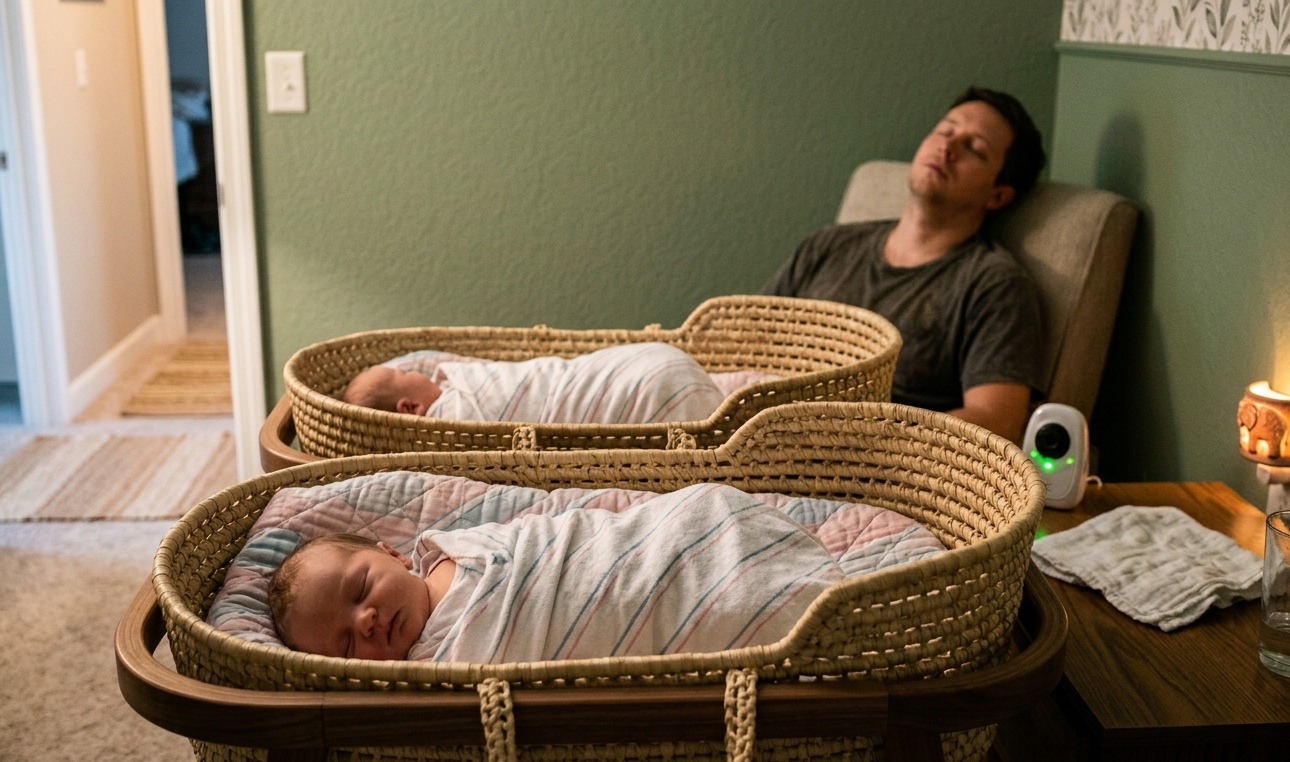
The first night home with both babies, I fed one, got her back to sleep, put her down, and the other one woke up. I fed her, got her back to sleep, put her down, and the first one woke up again. It was 4 a.m. and I had not slept and I genuinely could not remember which one I had fed last.
If you don’t get your twins on the same schedule, this is your life. You’re always feeding someone and you never sleep. Syncing them doesn’t happen automatically and it doesn’t happen fast, but it’s the most important thing you can do in those first weeks. Everything else flows from it.
The core of it is one rule: when one twin wakes to eat, wake the other. Build around that with wake windows and an eat-play-sleep cycle, and the schedule takes shape over the first 8 to 12 weeks. Below is how it works in practice, week by week, with the research behind it and the twin-specific logistics that make or break the whole thing.
The one rule that makes everything possible
When one twin wakes to eat, wake the other one too.
That’s it. That’s the foundation of every twin schedule that actually works. It sounds simple and it feels brutal at 2 a.m. when one baby is sleeping peacefully and you have to disturb them. Do it anyway. Every time you let one sleep while the other feeds, you push their cycles further apart. A 30-minute offset today becomes an hour by the end of the week.
The goal isn’t a rigid schedule where everything happens at exact times. The goal is that both babies are hungry at roughly the same time, sleep at roughly the same time, and give you a stretch of uninterrupted rest between cycles. That gap is what keeps you functional.
What “schedule” actually means in weeks one and two
In the first two weeks, there is no real schedule. There is just survival.
Newborns need 14 to 17 hours of sleep per 24-hour period, according to the American Academy of Sleep Medicine, but they take it in short, unpredictable bursts. Their stomachs hold very little, so they wake frequently to feed. You’re not building a routine yet. You’re establishing feeding, getting your milk supply going if you’re breastfeeding, and trying to make sure both babies are gaining weight. The pediatrician will be watching the scale closely in these early visits.
Here’s something that helps to know: newborns don’t have a functioning internal clock yet. Research on circadian rhythm development shows these rhythms don’t begin to develop until around 2 to 4 months of age. That means the structure you’re building in these early weeks isn’t teaching habits. It’s providing the external rhythm that your babies’ biology can’t yet generate on its own.
You are the clock. That’s a lot, but it also explains why newborn scheduling feels less like training and more like just holding everything together until their brains catch up.
What you can do in weeks one and two: start the sync. Every time one wakes, wake the other. Feed them at the same time or as close to it as possible. That’s your only job right now.
The schedule comes later. The sync starts on day one.
Wake windows: the concept that changes everything
A wake window is the amount of time a baby can comfortably stay awake before they need to sleep again. The biology behind it: while a baby is awake, a chemical called adenosine builds up in the brain, creating increasing sleep pressure. Stay within the wake window and there’s enough sleep pressure to settle easily. Go past it and stress hormones like cortisol kick in to compensate for the fatigue, which is why overtired babies fight sleep harder, not less. It sounds counterintuitive until you understand what’s actually happening.
For newborn twins, wake windows are very short:
0 to 4 weeks: 45 to 60 minutes total awake time, including the feeding itself. By the time they eat and you burp them, they’re almost ready to go back down.
4 to 8 weeks: 60 to 90 minutes. A little more alert time starts appearing after feeds.
8 to 12 weeks: 75 to 90 minutes. You’ll start to see more genuine awake and interactive time between feeds and naps.
These aren’t exact numbers. Babies vary. But they’re close enough to use as your guideline. If a baby has been awake 75 minutes and is rubbing their eyes or getting fussy, that’s your cue, not a problem.
One important note if your twins were born early: around 60% of twin pregnancies deliver before 37 weeks, so this isn’t uncommon. For premature babies, use their adjusted age (how old they would be if born at 40 weeks) rather than their actual birth age when estimating wake windows. A baby born at 34 weeks who is now 8 weeks old is developmentally closer to a 4-week-old. The windows will catch up, just on a slightly different timeline.
The reason wake windows matter for twins specifically: they help you predict when both babies will next need to sleep. When you’re feeding on the same cycle, both babies hit their wake window limit at roughly the same time. That’s how you get them both down for a nap simultaneously.
The eat-play-sleep cycle
Once you’re past the first two weeks, most families find it helpful to organize each cycle around a simple pattern: eat, then some awake time, then sleep.
Feeding first means babies get a full feed when they’re alert and hungry, not when they’re drowsy and half-committed. A baby who falls asleep mid-feed snacks rather than eating fully, which means they’re hungry again faster. Full feeds stretch the time between cycles.
The “play” part at this age is minimal: some tummy time, looking at your face, lying on a mat while you talk to them. You’re not doing much. But keeping them awake for a bit after the feed is what builds toward longer stretches of sleep.
Sleep follows naturally as the wake window closes.
Feed, awake time, sleep. Repeat. That’s the architecture of every newborn schedule that works.
Sample schedule: weeks 2 to 6
At this stage you’re working with roughly 2 to 3 hour cycles and both babies are feeding frequently around the clock. A realistic day looks like this:
7:00 a.m.: Wake both babies, feed both (tandem if possible, or one right after the other)
7:45 a.m.: Brief awake time, tummy time, burping
8:15 a.m.: Both down for nap
10:00 a.m.: Wake both, feed both
10:45 a.m.: Brief awake time
11:15 a.m.: Both down for nap
1:00 p.m.: Wake both, feed both
And so on through the day and night, every 2 to 3 hours.
The overnight feeds are part of this same cycle. At this age you’re getting up 2 to 3 times overnight. That’s normal and it doesn’t last forever.
One practical tip: pick an anchor time for the first morning feed and try to hold it consistent day to day. 7 a.m. works for many families. Starting the day at the same time gives the whole cycle something to organize around.
Sample schedule: weeks 6 to 10
By 6 weeks, most twins can stay awake a little longer between feeds and some families start to see one slightly longer overnight stretch, sometimes 3 to 4 hours between feeds at night.
A rough rhythm at this stage:
7:00 a.m.: Wake, feed both
8:00 a.m.: Awake time, interaction
8:45 a.m.: Nap
10:30 a.m.: Wake, feed both
11:30 a.m.: Awake time
12:15 p.m.: Nap
2:00 p.m.: Wake, feed both
Continue through the afternoon and evening with a similar rhythm. Overnight feeds are still happening but the gaps may start to lengthen slightly.
This is also the age when some families start to see the babies’ personalities around sleep: one who settles easily, one who fights every nap. That’s entirely normal and worth knowing ahead of time so you don’t assume you’re doing something wrong.
Sample schedule: weeks 10 to 14
Around 10 to 12 weeks, many twins start consolidating naps slightly and overnight sleep can improve meaningfully. Some families get a longer first overnight stretch of 4 to 5 hours, which starts to feel like a different life entirely.
7:00 a.m.: Wake, feed both
8:30 a.m.: Nap
10:30 a.m.: Wake, feed both
12:00 p.m.: Nap
2:00 p.m.: Wake, feed both
3:30 p.m.: Short nap
5:00 p.m.: Wake, feed both
6:00 p.m.: Bedtime routine begins
7:00 p.m.: Both down for the night
Overnight: One or two feeds, timing varies
The bedtime routine matters more now. Bath, feed, dim lights, same sequence every night. The routine signals what’s coming and helps both babies wind down together. Consistency here starts to pay off quickly.
Night feeds: what to expect and when things shift
In the first 6 weeks, you’ll be up 2 to 3 times overnight with both babies. That’s the reality and there’s no shortcut through it.
The shift usually starts somewhere between 8 and 12 weeks, when one or both babies starts naturally going a longer stretch between the last feed before bed and the first overnight wake. Some families see 4 to 5 hour stretches by week 10. Others are still up every 3 hours at 12 weeks. Both are within normal range.
What helps the overnight stretch lengthen: full feeds during the day, a consistent bedtime routine, and keeping overnight feeds quiet and boring. No talking, no bright lights, no stimulation. Feed, burp, back to sleep. You want them to understand overnight isn’t the social hour.
The light piece is backed by research. Because newborns are still developing their circadian systems, light is one of the primary external cues that helps calibrate their internal clock. Studies on infant circadian development recommend bright light exposure during daytime feeds and interactions, and darkness during overnight feeds. It sounds simple because it is. But it works, and the biology explains why: you’re giving their developing brain a consistent signal about when day ends and night begins.
If you want to understand what happens to sleep as the babies get older and the schedule matures, twin infants, sleep and you covers the full arc from newborn chaos to something resembling a normal night.
When one twin throws the whole thing off
It happens. One baby gets a cold, has a growth spurt, goes through a developmental leap, or just decides the schedule is no longer interesting to them.
When one baby disrupts the sync, resist the urge to let the other one drift onto their new timing. Keep waking the cooperative twin at the established times. A disruption is temporary. A desynchronized schedule is a project.
Growth spurts tend to cluster around 3 weeks, 6 weeks, and 3 months. During a growth spurt, babies feed more frequently for a few days and then settle back. Ride it out on the established framework rather than abandoning the schedule entirely.
Feeding and the schedule
Whether you’re breastfeeding, bottle feeding, or doing both, the schedule logic is the same: feed both babies at the same time as often as possible.
For breastfeeding, a twin nursing pillow makes tandem feeding realistic and is worth having before the babies arrive. Feeding one at a time means your feeding cycles take twice as long, which leaves almost no gap before the next cycle begins.
For bottle feeding, having a partner or support person handle one baby during feeds is a significant help, especially in the early weeks when burping and pacing take time.
Our breastfeeding twins guide and mastering the art of feeding newborn twins both go deeper on the logistics of feeding two babies efficiently.
The schedule changes. That’s the point.
Every schedule listed above has a shelf life of a few weeks. Just when you feel like you’ve got it figured out, the babies grow and the timing shifts. That is not failure. That is development.
The framework stays the same: sync them, watch wake windows, feed fully, build a bedtime routine. The specific times and durations adjust as the babies change.
By 3 to 4 months, most twin families have found a rhythm that feels manageable. Not easy, but manageable. The difference between no schedule and a loose one is the difference between drowning and swimming slowly. Start with the sync, hold the framework when it breaks, and adjust the times as the babies grow. The structure is what survives.
If you’re preparing for twins and want to know what else is coming, our guide on what to expect when you’re expecting twins covers the big picture from pregnancy forward.
Sources
- “Recommended Amount of Sleep for Pediatric Populations.” American Academy of Sleep Medicine, 2016. https://aasm.org/resources/pdf/pediatricsleepdurationconsensus.pdf
- Morales-Muñoz, I., et al. “The Development of Circadian Rhythmicity in Infancy.” Sleep Medicine Reviews, 2022. https://pmc.ncbi.nlm.nih.gov/articles/PMC9109407/