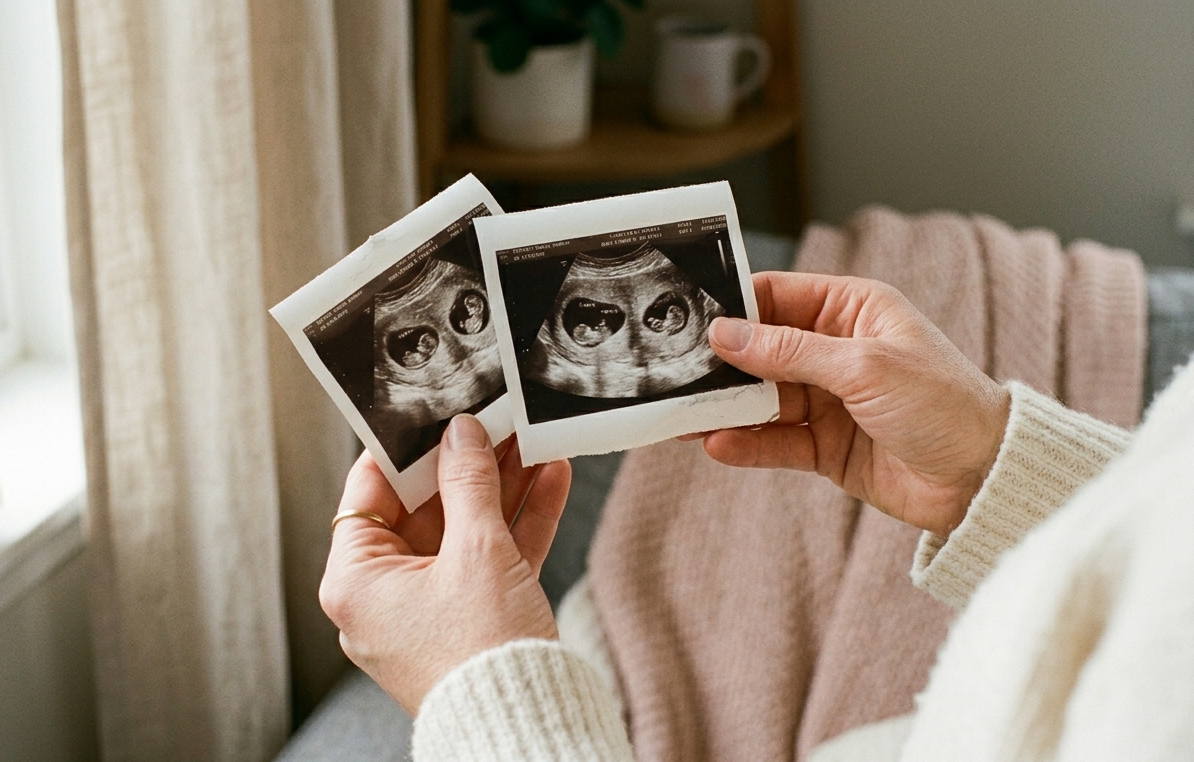
1 in 32
That’s the current chance of having twins in the United States, according to the CDC’s 2023 National Vital Statistics Report.
That number includes IVF pregnancies, which dramatically inflate the rate. For naturally conceived pregnancies, the odds of fraternal twins are closer to 1 in 90, and the odds of identical twins are roughly 1 in 250. If you’re not using fertility treatment and you don’t have specific risk factors, 1 in 90 is a more realistic starting point.
Whether your personal odds are higher or lower than that depends on several things, most of which come down to biology rather than anything you can control. Here’s what actually moves the needle.
Two Types of Twins, Two Completely Different Stories
Before getting into the factors, it’s worth knowing that about two-thirds of twin pregnancies are dizygotic (fraternal) and one-third are monozygotic (identical). These types form in entirely different ways, which is why almost everything that affects your twin odds applies only to fraternal twins.
Fraternal twins happen when the body releases more than one egg during ovulation and each is fertilized separately. The tendency to do this has a genetic component, is influenced by age and other biological factors, and can be affected by fertility medications. It runs in families. It varies by population. It’s the type of twinning that responds to circumstances.
Identical twins happen when a single fertilized egg spontaneously splits. Researchers don’t fully understand why this occurs. There’s no known inherited tendency that makes it more or less likely, and it appears to be essentially random. The rate of identical twinning stays roughly constant at about 1 in 250 across populations, regardless of age, family history, or most other factors.
So when people ask “what increases my chances of having twins,” what they’re really asking is “what affects my chances of having fraternal twins.” The answer to the identical twin question is short: not much.
What Actually Affects Your Odds of Fraternal Twins
Family History on Your Mother’s Side
If your mother or a maternal relative has had fraternal twins, your own odds are elevated. The mechanism is inherited hyperovulation: the tendency to release more than one egg per cycle runs in families through the maternal line.
Research cited by MedlinePlus Genetics notes that women who are themselves fraternal twins give birth to twins at roughly twice the rate of the general population. If your mother is a fraternal twin, some estimates put your odds at around 1 in 17.
Importantly, family history on the father’s side doesn’t affect your current odds of conceiving twins. A man can carry a hyperovulation gene and pass it to his daughters, but it has no bearing on his partner’s ovulation. The deciding factor is whether you, the person who will be ovulating, have inherited that tendency.
Your Age
Women over 35 have higher rates of fraternal twin pregnancies, and the effect increases through the late 30s. As women age, the body produces more follicle-stimulating hormone (FSH) to compensate for declining egg quality. Higher FSH can push the ovaries to release more than one egg per cycle.
This is one of the reasons twin rates climbed in the US over recent decades. According to CDC NCHS data, the average age of mothers at first birth increased substantially from 1980 to 2014, and this shift in maternal age accounts for roughly a third of the rise in twin births over that period.
Race and Ethnicity
Fraternal twin rates vary significantly across populations. The Yoruba people of southwestern Nigeria have the highest documented fraternal twin rate in the world. Research published in PMC documents rates of approximately 45 twin births per 1,000 live births in some communities there, compared to the US average of 30.7. Women of East Asian descent have among the lowest fraternal twin rates globally. These differences appear to reflect inherited variation in the tendency to hyperovulate.
BMI
A 2005 study in Obstetrics & Gynecology analyzed more than 51,000 pregnancies from an era before fertility drugs were common, providing a relatively clean look at natural twinning. Women with a BMI of 30 or above were approximately 1.5 times more likely to conceive fraternal twins than women with a BMI in the normal range. Taller women also had slightly elevated rates.
The likely explanation is insulin-like growth factor (IGF), which is higher in women with greater body mass and may increase ovarian sensitivity to FSH.
Number of Prior Pregnancies
Women who have carried more pregnancies tend to have modestly higher rates of fraternal twinning. Baseline FSH rises slightly with each pregnancy, for the same hormonal reasons as the age effect. This is a smaller factor than the others above, but it’s real.
The Genetics: What Research Has Found
The most precise look at why fraternal twinning runs in families comes from a 2016 genome-wide association study in the American Journal of Human Genetics. Researchers studying nearly 2,000 mothers of spontaneous fraternal twins identified two specific gene variants associated with increased twinning:
One, near the FSHB gene, is linked to higher circulating FSH. Women with this variant showed an 18% increase in twin odds per copy. The other, within the SMAD3 gene, affects how the ovaries respond to FSH, adding another 9% per copy. Women who carried both variants showed a combined increase in fraternal twin odds of about 29%.
This research doesn’t mean that having fraternal twins in your family guarantees twins for you, but it confirms that the tendency is real, genetic, and measurable at the molecular level.
Fertility Treatment: The Biggest Single Factor
If you use fertility treatment, the math changes dramatically.
IVF with multiple embryos transferred results in twins in approximately 30% of pregnancies, according to the American Society for Reproductive Medicine. Fertility medications like Clomid or injectable gonadotropins, which stimulate the ovaries to produce multiple eggs, carry twin rates of roughly 1 in 35.
The CDC estimates that fertility treatments account for roughly two-thirds of the entire rise in US twin rates between 1980 and 2009. It’s by far the largest driver of twin pregnancies nationally, which is why the “1 in 32” headline figure is so different from the “1 in 90” natural rate.
If you’re pursuing fertility treatment and want to minimize your odds of twins, the relevant conversation is with your reproductive endocrinologist about single embryo transfer and protocol choices. If you’re trying to conceive naturally and wondering whether there’s a treatment-free way to increase your odds, the honest answer is: not really, and here’s what the evidence actually shows.
Things People Claim Increase Your Chances (With What the Research Actually Says)
There’s a lot of folklore around this topic. Some of it has a kernel of science underneath it. Most doesn’t.
Yams and Cassava
The world’s highest fraternal twin rate belongs to a Yoruba community in southwestern Nigeria, where yams and cassava are dietary staples. The obvious question is whether the food is responsible.
Researchers have explored this. A qualitative study published in PLOS One examined community beliefs in Igbo-Ora, where residents pointed to local dishes made with okra leaves and cassava as possible contributors. The most popular theory involves phytoestrogens in these foods stimulating hyperovulation. It’s an interesting hypothesis, but the evidence is observational and inconclusive. The Yoruba population also has strong genetic predispositions toward hyperovulation, making it essentially impossible to isolate a dietary effect from the genetic one.
Eating yams is not a reliable method for increasing twin odds.
Folic Acid
Several studies have found a statistical association between folic acid supplementation and slightly elevated fraternal twin rates. A Swedish study found an odds ratio of about 2.13 for twin births among women who had taken folic acid supplements compared to those who hadn’t, after adjusting for age and other factors.
But as multiple follow-up analyses have noted, this association is deeply complicated by confounders. Women who take folic acid supplements are also more likely to be trying to conceive, more likely to be using fertility treatments, and more likely to be older. After accounting for those factors, the evidence for an independent folic acid effect is weak and inconsistent.
Take folic acid because it reduces the risk of neural tube defects. Don’t take it expecting twins.
Stopping Birth Control
There is a real but small biological effect here. When hormonal birth control is discontinued, some women experience a brief period where FSH levels are elevated as the body re-establishes its natural cycle. This can occasionally result in hyperovulation in the first cycle or two, which could in theory increase twin odds.
A study published in PMC found some evidence of increased twinning in the months immediately following pill discontinuation. However, even in that window, the absolute effect is small. The increased risk applies only to the rebound period, normalizes within a few cycles, and doesn’t add up to a meaningful strategy.
Dairy Products
A study by researcher Gary Steinman proposed that women who consume dairy products have higher circulating levels of IGF (insulin-like growth factor), which may stimulate the ovaries, and found that vegan women had twin rates about one-fifth that of women who ate dairy. It’s a frequently cited finding. It’s also a single study that has not been replicated robustly, and IGF levels vary significantly across individuals for many reasons.
Dairy isn’t a reliable twin strategy either.
What This Means Practically
The honest summary is that your fraternal twin odds are mostly determined by factors you were born with: your genetics, your age, and your physiology. Fertility treatment is the one reliable external variable that substantially changes the math.
If you have a family history of fraternal twins, you’re over 35, or you’re using fertility treatment, your odds are meaningfully higher than average. If none of those apply, they’re close to baseline.
Quick Reference
| Situation | Approximate Twin Odds |
|---|---|
| All US births (including IVF) | ~1 in 32 |
| Natural conception, general population | ~1 in 90 (fraternal) / 1 in 250 (identical) |
| Age 35 or older | Elevated; increases through late 30s |
| Mother or close maternal relative had fraternal twins | ~1 in 17 to 1 in 30 depending on relationship |
| BMI 30 or above | ~1.5x baseline |
| IVF with multiple embryos transferred | ~1 in 3 |
| Fertility medications (Clomid/gonadotropins) | ~1 in 35 |
Already Have Twins and Wondering About Next Time?
The recurrence picture is quite different from the first-time odds. If your first set was fraternal and naturally conceived, your body has already demonstrated the hyperovulation tendency, and your odds for another set are substantially elevated.
Read: Chances of Having Twins Again: What Are the Real Odds?
Sources cited in this article:
- CDC/NCHS, Births: Final Data for 2023, National Vital Statistics Reports
- CDC/NCHS, Three Decades of Twin Births in the United States, 1980-2009, Data Brief No. 80
- StatPearls, Twin Births, NCBI Bookshelf
- American Society for Reproductive Medicine, Multiple Pregnancy and Birth
- Mbarek et al., Identification of Common Genetic Variants Influencing Spontaneous Dizygotic Twinning and Female Fertility, American Journal of Human Genetics, 2016
- Steinman, Relationship of maternal body mass index and height to twinning, Obstetrics & Gynecology, 2005
- Nylander, Frequency of twinning in southwest Nigeria, PMC
- Adeyemi-Fowode et al., Community perceptions on causes of high dizygotic twinning rate in Igbo-Ora, PLOS One, 2020
- Vollset et al., Effects of folic acid fortification on twin gestation rates, PubMed
- Rothman, Is there an increased risk of twinning after discontinuation of the oral contraceptive pill?, PMC
- MedlinePlus Genetics, Is the probability of having twins determined by genetics?