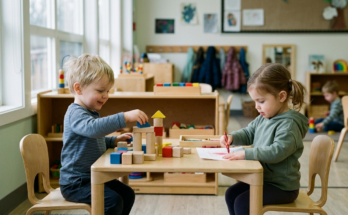
Before our girls started kindergarten, someone at the school told us they had a policy: twins are separated. That was just how it was done. No discussion, no consideration of the specific kids, no flexibility.
We pushed back. We asked what the policy was based on. The answer, essentially, was that it was better for twins to develop independently and that separation helped with that. When we asked whether there was research supporting this, the conversation got a little uncomfortable.
There was not. And there still is not, at least not in the way most schools assume. It turns out “we’ve always done it this way” is not a peer-reviewed study.
What Most Schools Do, and Why It Is Not Based on Evidence
The default policy at many elementary schools is to separate twins automatically. The reasoning usually sounds something like this: twins need to develop their own identities, they will distract each other in class, and separation helps them become more independent.
These are reasonable-sounding ideas. They are also not supported by the research.
Multiple large studies have looked at academic achievement, cognitive development, reading ability, and social behavior in twins kept together versus twins separated. What they found, consistently, is that it does not matter much. Twins kept together perform just as well academically as twins who are separated. And twins who are separated do not show the gains most schools seem to expect from the policy.
One of the largest studies on this question, published in Developmental Psychology, analyzed data from thousands of twin pairs ages 7 to 16 across the UK and Canada. The researchers found almost no sizable positive or negative average effect of classroom separation on academic achievement, cognitive ability, or motivation. At ages 12 and 16, the weak effects that did appear actually favored twins who had been educated together.
A separate study published in Educational Policy, which followed 560 twin pairs in Quebec through elementary school, found that sharing a classroom was associated with less social withdrawal at ages 6 and 10, and modestly lower levels of physical aggression and inattentive behaviors at age 12. The effect sizes were small and the findings are observational, but the direction is notable: keeping twins together did not harm them socially.
The Goldsmiths University research team that analyzed the UK portion of the large longitudinal study concluded plainly that there is no evidence for separation rules.
This does not mean separation is wrong for every twin pair. It means the blanket assumption that separation is better has no scientific basis. The decision should be made based on the specific children in front of you, not on a default policy.
What the Research Does Say Matters
When researchers dug into what actually predicts outcomes for twins in school, they kept finding the same thing: the twins who get separated are often the ones who were already showing behavioral or academic differences. The separation and the outcomes are both responding to the same underlying situation. Separation did not cause the difference. The difference was already there.
So if your twins are separated and one seems to do better, that child may well have already been doing better before the move, and that is part of why separation happened in the first place.
The research also found that when twins share a classroom for more years, the positive social behavior effects tend to be stronger. Longer co-placement was associated with less aggression at age 12, not more.
None of this is a mandate to keep all twins together. It is a reason to stop treating separation as the automatically correct choice.
What the Law Says in Your State
Here is the part that surprises most parents: in a number of states, schools are legally required to honor the parental preference for twin classroom placement. Not every state has this, and even where it exists the laws include conditions. But in several states, you have real legal standing to make this decision, not just the right to ask nicely.
The general structure where these laws exist: parents of twins enrolled in the same grade at the same school submit a written request for same or separate placement, and the school must generally honor it, subject to deadlines and exceptions for situations like capacity constraints, IEP considerations, or documented evidence that a specific placement would be harmful.
A few specific states, with their key details:
- Massachusetts (Chapter 71, Section 90): parents may request same or separate placement; request must be submitted within 14 days of the school year starting
- Minnesota: parent-discretion statute enacted in 2005; school provides requested placement subject to a 14-day request window and board review
- Georgia (Section 20-2-71): school must place twins as requested unless documented performance evidence shows otherwise; request window is 5 days before or after school starts
- Pennsylvania (Title 24, Section 13-1310.1): parents may request placement; school generally honors it with a 10-day deadline and exceptions for disruption or capacity
- New Jersey (Section 18A:36-38): applies to K through 8; parents submit a written request within 14 days; grades 9-12 are at principal discretion
- North Carolina: statute requires providing requested placement subject to capacity and timing conditions
- Tennessee: law requires boards to give preference to parent requests; note this is preference, not an absolute right to the requested placement
- Virginia: local boards are required to adopt policies for multiple-birth siblings that include a parent-request process
If your state is not on this list, it is worth checking your state’s education code directly before accepting a school’s default policy. And even in states without a specific law, raising the issue early (before class lists are posted rather than after) gives you a better chance of being accommodated. Schools generally have more flexibility in the planning phase than once assignments are set.
Factors That Actually Matter for Your Kids
Since the research does not give a universal answer, the decision comes down to your specific children.
The most useful question is how dependent they are on each other socially. Some twins have a healthy, easy relationship and function well alongside each other without leaning on one another constantly. Others have developed a dynamic where one defers to the other, one speaks for both, or one is socially dependent in a way that might be worth gently disrupting. Only you know which you are dealing with.
Also worth thinking about: are they at different developmental stages? Even same-age twins can be at meaningfully different places academically. If one is significantly ahead in reading or math, being in the same classroom means one teacher managing a wider gap. Separate classes can give each child a better-paced environment.
Classroom conflict is its own category. Some twins compete in ways that motivate both of them. Others compete in ways that are genuinely hard on everyone: one undermining the other, rivalry spilling into class, teachers stuck in the middle. If that dynamic is already showing up, separation is worth considering on those grounds specifically, regardless of what the research says about averages.
What does each twin want? This matters more as kids get older. A six-year-old may not have a strong opinion. A nine-year-old probably does, and it is worth asking. If they agree (both want together, or both want separate), that is often the simplest answer.
One more thing people overlook: the teacher assignments themselves. Sometimes the real question is not together or separate but which teacher is the better fit for each child. If one classroom has a teacher who is clearly a better match for one of your twins, that may drive the decision more than anything else.
How to Have the Conversation with the School
If your school has an automatic separation policy and you want to push back on it, here is how to approach it.
Request a meeting before school starts rather than trying to address it once placements are posted. Schools are far more flexible before the class lists are finalized than after.
Come in with your reasoning specific to your children. “We want them together because they are socially well-adjusted and there is no research supporting automatic separation” lands differently than “we just want them together.” You are more likely to be taken seriously if you have thought it through.
If you are in a state with a twin placement law, mention it. Politely. You do not need to lead with it as a threat, but schools are more responsive when they know a parent is aware of their legal options.
If you are asking for separation but the school wants to keep them together, the same principle applies: be specific about why, frame it around your kids’ needs rather than a general preference, and be willing to revisit it at the semester if it is not working.
What to Do If It Is Not Working
Whatever placement you start with, plan to check in honestly around the six-week mark. The first few weeks of kindergarten are chaotic for every family, so give the situation time to settle before drawing conclusions. But by six weeks, you should have a sense of whether the placement is causing problems.
Signs that a together placement may not be working: one twin consistently speaks for the other in class, a teacher is spending disproportionate time mediating between them, or one twin’s social development seems to be stalled in a way that the proximity may be feeding.
Signs that a separate placement may not be working: one or both twins is visibly struggling with the separation in a way that is not improving with time, anxiety that is specific to school rather than generalized, or a teacher reporting that one twin seems to be spending energy worrying about the other rather than engaging with class.
If things are not working, go back to the school. Ask for a reassessment. Mid-year changes are harder to arrange but not impossible, and most schools would rather adjust placement than watch a child struggle for a full year.
The goal is not to be right about the original decision. The goal is to keep paying attention to the kids in front of you.
Sources
- Twin classroom dilemma: To study together or separately? Developmental Psychology, 2018. PubMed 29658740
- Classroom Placement and Twins’ Social Behaviors in Elementary School. Educational Policy, 2022. Sage Journals
- Does Classroom Separation Affect Twins’ Reading Ability in the Early Years of School? Twin Research and Human Genetics, 2014. PMC3915871
- Twins in class: no evidence for separation rules. Goldsmiths, University of London. gold.ac.uk
- Massachusetts General Laws, Chapter 71, Section 90: Classroom placement of twins. malegislature.gov
- New Jersey Statutes Section 18A:36-38: Classroom placement of twins. Justia
- Georgia Code Section 20-2-71: Placement of twins in the same classroom. Justia