
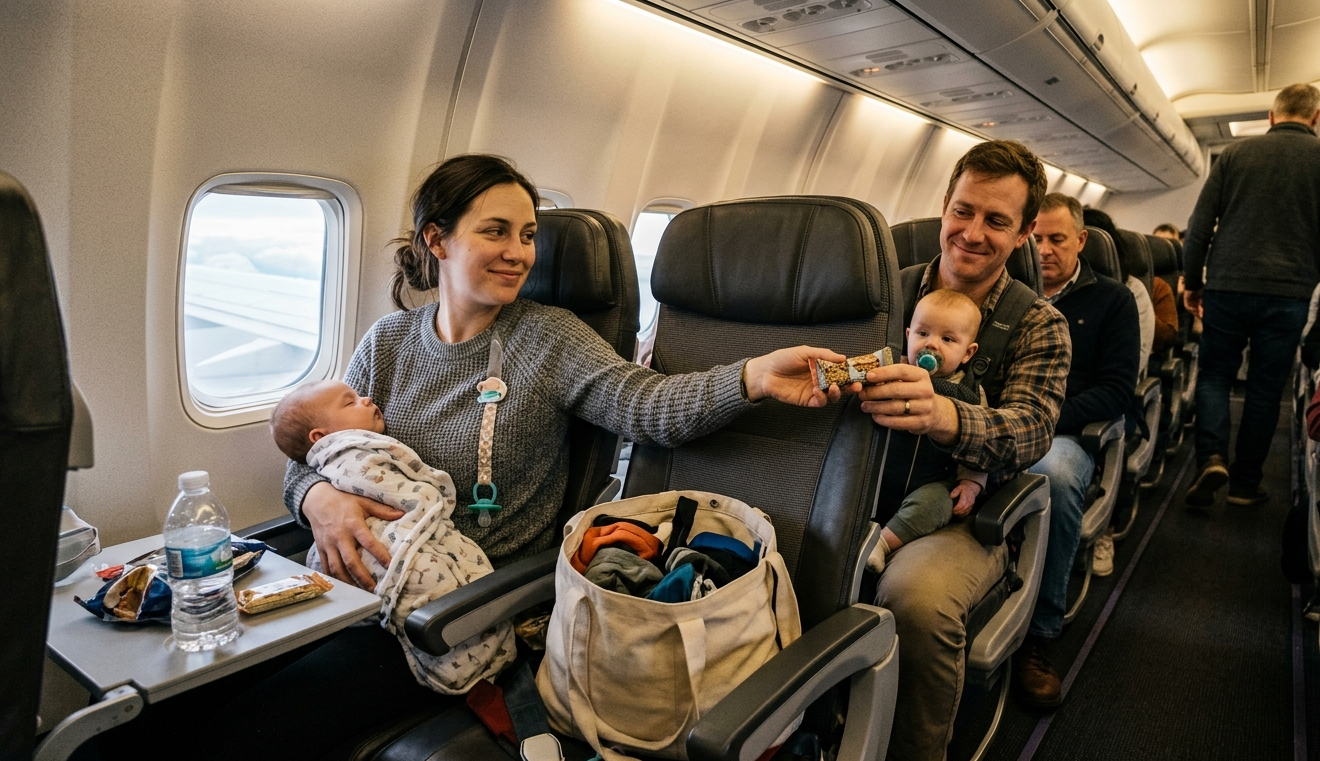
The first time I flew with my girls, they were eight months old and I was convinced we were going to be that family. The ones everyone on the plane quietly dreads. My husband was in the row ahead of me, one baby each, because that is the only way it works with two lap infants. We passed snacks and wipes back and forth over the seat like a relay race. We were not a disaster. It was loud at one point, we went through an alarming number of wipes, and one of my daughters slept through the entire descent while the other tried to grab the hair of the passenger in front of us. But we got there.
Flying with twins is manageable. It takes more planning than flying alone, or even flying with one baby, but it is not the ordeal it sounds like from the outside. The key is knowing the rules before you book, packing in a way that makes sense for two, and adjusting your expectations about what a smooth flight actually looks like when you have twins.
Here is what you actually need to know.
The Lap Infant Rule Twins Parents Need to Understand
If your twins are under two, you have the option to fly with them as lap infants, which means they fly without a purchased seat and sit on your lap during the flight. No additional ticket required. But there is a catch that surprises a lot of twin parents: due to oxygen mask allocation, airlines only allow one lap infant per row.
That means if both of you are flying together, you cannot sit in the same row with one baby each. The closest configuration allowed is one row in front of the other. The most practical setup is aisle seats in consecutive rows, so each adult is on the aisle with a lap infant and you can easily pass things back and forth.
If you are flying solo with both twins, one of them will need a purchased seat. There is no workaround for this.
It is also worth knowing what the FAA actually recommends: the safest place for any child under two on an airplane is in an approved child restraint system in their own seat, not on a lap. Your arms cannot hold a child securely during unexpected turbulence. Lap infant status exists, but buying seats and bringing car seats is the safer option if it is within your budget.
If you do buy seats for your twins, the car seat must be FAA-approved for aircraft use and labeled as such. For older toddlers who meet the weight requirements, the CARES harness (a FAA-certified supplemental harness that works with the existing aircraft seatbelt) is a lighter alternative to hauling two car seats through an airport.
When Is the Easiest Time to Fly?
There is a window, and it helps to know it.
The easiest ages for flying with twins tend to be roughly 3 to 9 months. At this stage they sleep a lot, they are not yet mobile, and they can be soothed reliably with feeding or a pacifier. A fed, sleepy infant on a plane is about as low-drama as it gets.
The hardest stretch is 9 to 18 months. This is the phase where babies are done sitting still, have opinions about everything, and cannot yet be reasoned with or distracted by a screen. Multiply that by two and you have a flight that requires maximum patience and minimal expectations.
After 18 months, and especially once they clear two years old, things get more manageable again. At two they start developing longer attention spans and you can lean on tablets, headphones, and snacks as real tools. If you have flexibility over when to take a family trip, it is worth factoring this in.
Booking: What to Do Before You Get to the Airline Website
Go direct. If at all possible, book a nonstop flight. A connection with twins means navigating a second security line, a second gate, and the possibility of a missed flight while you are changing two diapers in an airport bathroom. The extra cost of a nonstop is almost always worth it.
Call the airline after booking. Airlines have specific seating configurations for lap infants and not all of them are easy to set up online. Call customer service, explain that you have twin lap infants, and confirm the seating. Get it sorted before you arrive at the airport.
Book an early morning flight. Twins who are still on a regular sleep schedule tend to be most settled in the morning. An 8am flight is harder on you, but easier on them, than a 3pm flight that cuts through naptime.
Request a bulkhead or bassinet row if available. On longer international flights, many airlines offer bassinets at the bulkhead for infants. Bassinets are allocated on a first-come basis and size limits apply, so call early. The bulkhead also gives you more floor space, which matters more than it sounds when you are managing two babies.
At the Airport
Give yourself more time than you think you need. With twins, everything takes longer: security, bathroom stops, the walk to the gate. Arriving 30 minutes earlier than you normally would is not excessive.
Gate check your stroller. You can use your double stroller all the way to the gate and check it there for free on most airlines. It will be waiting for you at the jet bridge when you land. A lightweight umbrella-style double stroller is the easiest to maneuver through terminals and the easiest to fold and hand off at the gate. Note that American Airlines restricts gate-checked strollers to those under 20 pounds, so if you are flying American, check your stroller weight before you travel.
Change diapers at the gate, right before boarding. Not 45 minutes before. Right before. You want both babies as fresh as possible before you get on the plane, where the changing situation is going to be more complicated.
Take advantage of family boarding. Most airlines offer early boarding for passengers with young children. Use it. The extra five minutes to get settled, stow your bags, and get everyone situated is genuinely valuable.
Seating Strategy
For two adults with twin lap infants: aisle seats in consecutive rows is the standard approach. You are close enough to hand things to each other, each baby has a parent, and you are both on the aisle so neither of you is trapped against a window when you need to move.
For two adults with seats purchased for both twins: a row of four works well if you can get it. Window seat gets the car seat, then baby, then parent in the middle, and you use the remaining seats strategically. Talk through configurations with the airline when you call.
Avoid exit rows entirely. Lap infants are not permitted in exit rows or the rows immediately before and after them.
Packing the Carry-On
Two babies means twice the supplies, but the carry-on still has limits. The goal is to pack everything within easy reach without creating an avalanche every time you open a bag.
Use small pouches rather than one large bag. One pouch for diapers, wipes, and a changing mat. One for snacks and feeding supplies. One for a spare outfit per baby (yes, per baby, because at least one blowout is a near-certainty). Small and organized beats large and chaotic when you are trying to find a pacifier one-handed at 30,000 feet.
Pack for the flight plus a buffer. If the flight is two hours, pack for three hours of diapers and feeding. Delays happen.
For infants: bottles or nursing supplies, pacifiers, one comfort item per baby, a lightweight blanket. For toddlers: add a tablet loaded with downloaded content (streaming does not work at altitude on most domestic flights), child-safe headphones, a small activity like window cling stickers or a simple toy that does not have a hundred pieces. Snacks that take a while to eat earn bonus points.
Ear Pain at Takeoff and Landing
This is the piece most parents are worried about and it is also the most manageable.
Ear pain during flight is caused by air pressure changes, and for young children whose ear anatomy is still developing, it can be more intense. The solution is straightforward: get them swallowing during takeoff and descent. Swallowing helps equalize the pressure.
For infants, nursing or bottle feeding during takeoff and landing is the most effective strategy. Time the feeding so they are hungry enough to actually drink. A baby who is actively nursing during descent is a baby who is probably not screaming about her ears.
For toddlers, a sippy cup of water, a snack that requires chewing, or a pacifier all accomplish the same thing. KidsHealth from Nemours recommends keeping them awake during pressure changes since children swallow more often when awake. An asleep toddler cannot swallow, so if you can, keep them up through takeoff and early descent.
If either twin has a cold or ear infection before the flight, talk to your pediatrician. Flying with active congestion can make the pressure issue significantly worse and your doctor can advise on timing or whether to postpone.
Flying Solo with Twins
If you are making this trip without another adult, it is harder but absolutely doable. A few things that help:
Wear one twin in a carrier through the airport while the other rides in a single stroller. You still have two hands partially free. This is not comfortable for long stretches but it gets you from security to the gate.
Accept help when it is offered. Flight attendants, gate agents, and fellow passengers offering a hand are giving you a gift. Take it.
If your twins are still lap infants and you are flying alone, you will need to purchase a seat for the second baby and bring a car seat or CARES harness. There is no configuration where one adult can safely hold two lap infants.
Pack everything within reach of where you will be sitting. With no second adult to play supply runner, you cannot afford to have anything important in the overhead bin.
What the Flight Actually Looks Like
Here is the honest version: it is rarely perfectly calm and it is almost never the disaster you imagined.
There will probably be a stretch where one or both of your girls is done with the situation. You will feel every set of eyes in the vicinity. You will feel guilty about it even though you are doing your best and everyone on that plane was once a child who was also sometimes loud in public.
The flight ends. You get off the plane. On the other side of it is wherever you were going, and it will have been worth it.
For more on keeping two toddlers on a workable routine, which matters just as much on travel days, our article on staying sane with twin toddlers covers the strategies that help. And if you are still in the infant feeding stage and figuring out schedules around travel, our guide on feeding newborn twins has the logistics.

