When my girls were around 18 months, I mentioned to our pediatrician that one of them wasn’t saying much. Maybe five or six words, mostly just pointing and grunting at things she wanted. The pediatrician nodded and said something I found both reassuring and slightly unsatisfying: “Twins often run a little behind on language. Keep an eye on it.”
Keep an eye on it. Sure. That is what you do when you are already watching two toddlers sprint in opposite directions all day.
If you are in a similar spot, noticing your twins seem quieter than other kids their age, or wondering whether what you’re seeing is normal twin development or something that needs attention, this is what I wish someone had laid out for me clearly.
Yes, Twins Really Do Have Higher Rates of Speech Delay
This is not a myth or parental overworrying. The research is consistent and the numbers are significant.
Studies have found that twins are roughly twice as likely as singletons to experience early language delay. One study of nearly 500 twin pairs found that 47% of 24-month-old identical twins had language delay, compared to 31% of fraternal twins. Another found that 71% of 2-year-old twins were not yet combining words, versus 17% of singletons the same age.
Those are not fringe numbers. Nearly half of identical twins at age two showing some degree of language delay is a documented pattern with real causes.
Why This Happens
There are a few overlapping reasons, none of which are about you being a bad parent.
Each twin gets less directed speech. Research is clear that it is speech addressed directly to a child, not speech overheard in the background, that builds vocabulary. A 2015 study published in PMC found that infants who experienced more child-directed speech had significantly larger expressive vocabularies by 24 months. When you have two babies, each one gets roughly half the one-on-one language time a singleton would get. That math is structural, not a failure of effort.
Twins talk to each other. A lot. And they are talking to another developing, imperfect speaker rather than a fluent adult. They are hearing approximations reinforced rather than corrected toward standard speech. That is not harmful in itself, but it does slow the process.
Cryptophasia. Up to 50% of young twin pairs develop some form of private communication between them: their own sounds, gestures, and invented words that make sense to each other but not to anyone else. Researchers call this cryptophasia. A study published in PMC found it stems from the same reduced parental input and intensive twin-to-twin interaction that underlies language delay more broadly. It is not a separate pathology. Most twins naturally move away from it when they enter wider social environments like playgroups or preschool.
Male twins tend to show a greater lag than female twins, typically around six months, consistent with the broader pattern of boys developing language slightly later than girls.
The Good News, Backed by Research
A major longitudinal study published in the Journal of Speech, Language, and Hearing Research tracked 627 twin pairs from ages 4 to 6. The findings were clear: the gap narrows over time, and by age 6, differences related to twin type disappear entirely. Most twins catch up to singleton peers by 3 to 4 years of age.
The researchers were also explicit that early twin-related language delay does not signal the same kind of persistent language impairment seen in children with specific language disorders. The delay is real, but for most twins, it is not the beginning of a longer-term problem.
That said, “most twins catch up” is not the same as “all twins catch up.” And waiting to see is only a reasonable plan if you know what you are watching for.
Milestones to Know
Standard speech milestones apply to twins, not a separate twin timeline. If your twins were born premature, use their adjusted age when tracking milestones, the same way you would for any developmental marker.
The American Speech-Language-Hearing Association and the National Institute on Deafness and Other Communication Disorders publish detailed milestones. The ones that matter most in the toddler years:
By 12 months: Babbling with different sounds, using gestures like pointing and waving, responding to their name.
By 18 months: Using at least 10 words consistently, following simple one-step directions, pointing to familiar objects when named.
By 24 months: Using at least 50 words, starting to combine two words (“more milk,” “daddy go”), speech understandable to caregivers about half the time.
By 3 years: Using three- to four-word sentences regularly, strangers able to understand them most of the time, asking and answering simple questions.
Missing milestones by a few weeks is not the same as missing them by several months. A twin at 24 months who has 30 words and is starting to combine them is in a different position than one who has 5 words and is not gesturing. Both need watching, but differently.
What You Can Do at Home
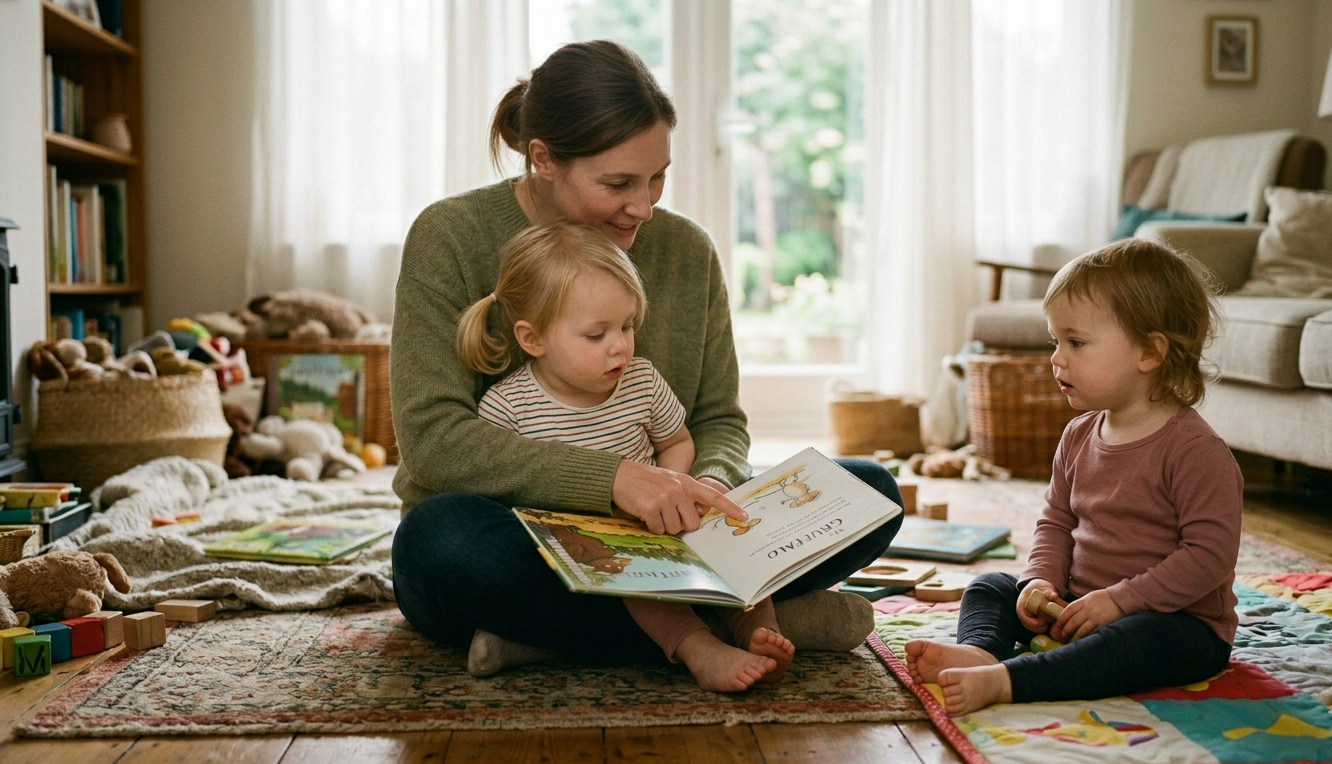
The most effective strategy is also the hardest with twins: one-on-one time with each child.
A 2015 study in PMC on parental language input and twin development found that directed speech (speech aimed specifically at the child who is right in front of you) is what moves the needle. Not background conversation, not talking to both twins at once. Even 10 to 15 minutes a day of focused one-on-one with each twin, where she is not competing for your attention or your words, can make a measurable difference. If you are already working on keeping two toddlers on a predictable routine, building that individual time into an existing part of the day (naptime rotation, bedtime, bath) is easier than carving it out from scratch.
A few other things that help:
Name what you point to. A 2021 study from Georgia State University found that for twins specifically, gestures paired with named objects accelerate vocabulary acquisition. When you pick up a banana and say “banana,” you are doing something more useful than it sounds.
Talk directly to each child, not at the room. Get down to their level, make eye contact, and address them by name. “Sofia, do you want more water?” lands differently than a general “Does anyone want water?”
Read to each twin separately when you can. Even a few nights a week of individual book time is valuable. It creates a window of focused language interaction that does not have to be split.
Do not suppress twin talk. If your girls have their own sounds and words for each other, that is fine. Do not stress about it or try to stamp it out. Just make sure each child is also getting plenty of adult-modeled language alongside it.
The Question a Lot of Twin Parents Are Actually Thinking About
Many parents searching for information about twin speech delay are quietly wondering about something else: could this be autism?
It is worth addressing directly, because many parents are already thinking about it.
Speech delay is one of the early signs associated with autism, but speech delay alone does not indicate autism. The key distinction lies in how children communicate beyond words. Children with an isolated speech delay typically compensate actively: they point to things they want, make eye contact, bring objects over to show you, wave, nod, and work hard to get their needs across even without much language. They are communicating. Just not with words yet.
The red flags that suggest something beyond speech delay include: not pointing by 12 months, not responding to their name consistently, limited eye contact during interaction, not bringing objects to show you, no pretend play by 18 months, and repetitive behaviors that seem fixed and hard to redirect. These signs, especially in combination, are worth raising with your pediatrician promptly. Not to catastrophize, but because early evaluation and early support make a real difference in outcomes.
Twin parents should also know that autism can be harder to identify in twins because the shared environment and twin-to-twin communication can mask some early signs. If something feels off beyond what you can explain as “they’re twins,” trust that instinct and get an evaluation. You are not overreacting.
When to Seek a Speech Evaluation
The American Academy of Pediatrics recommends raising language concerns at well-child visits, and your pediatrician can refer you to a speech-language pathologist for a formal evaluation. In many cases, you do not need to wait for a referral. You can contact a speech-language pathologist directly.
Seek an evaluation if your child:
- Has no words by 15 to 18 months
- Is not combining two words by 24 months
- Seems to be losing words or skills they previously had
- Is hard to understand by age 3 even to people who know them well
- Is showing any of the autism red flags listed above
An evaluation is not a diagnosis, and it is not a commitment to therapy. It is an hour or two with a specialist who will tell you where your child actually stands. Many parents come out of evaluations reassured. Some come out with a plan for therapy. Either outcome is better than waiting and wondering.
ASHA is explicit that early intervention before age 3 produces the fastest and most lasting results for children with language delays. Services are federally mandated for children under 3 through Early Intervention programs, which means evaluation and therapy are often available at no cost. After age 3, services shift to the school district. But the window before 3 is the one you want to use if you can.
One More Thing About the Comparison Trap
Twin parents are especially prone to comparing their kids: to singletons, to other twins, and to each other. Try not to let comparison become the whole story.
If one of your twins is ahead of the other on language, that is not automatically a problem in the lagging one. Twins develop at their own pace even within the same household with the same parents. What matters is whether each child is moving forward, whether the gap is stable or widening, and whether the signs above are present.
What you know about your children, the instinct you have built from being with them every day, is worth something. If something feels off to you, that feeling deserves to be taken seriously by a professional. Bring it up. Push for the evaluation if you have to. You are not catastrophizing. You are paying attention.
For more on managing the toddler years with twins, including the energy and chaos that come with this stage, our article on staying sane with twin toddlers covers the bigger picture of what this phase actually looks like day to day.